
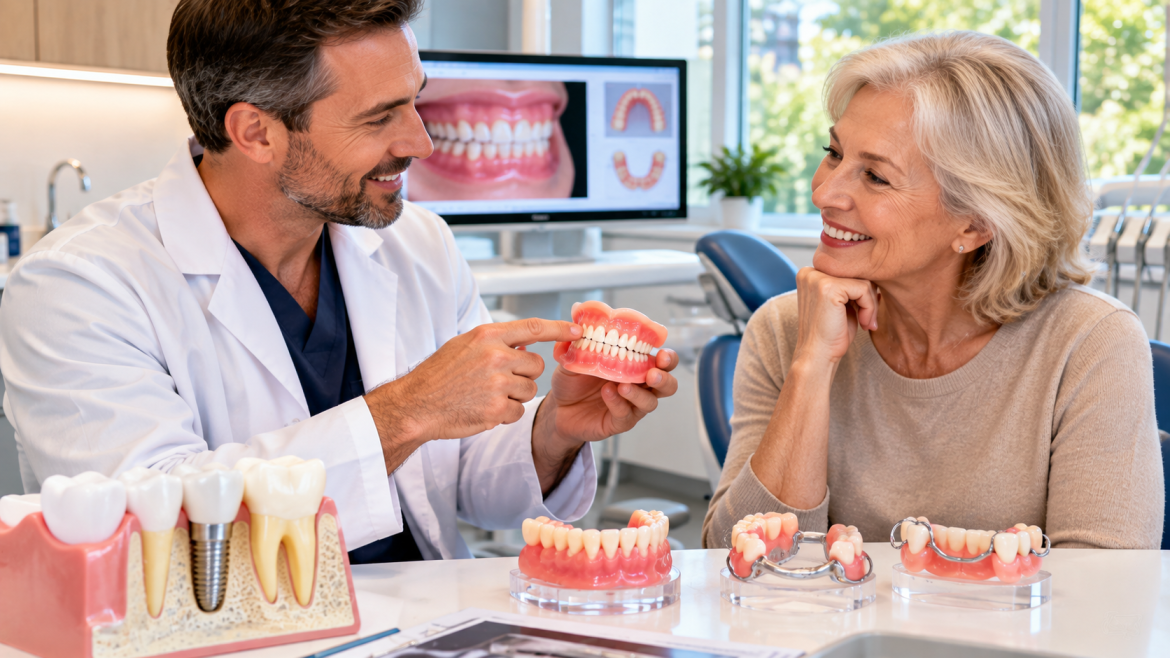
Losing several or all of your natural teeth can significantly change everyday life. Eating certain foods may become difficult, speech can change, and many people become less comfortable smiling. Fortunately, modern dentures provide an effective way to replace missing teeth and restore much of the appearance and function of a natural smile.
- Dentures are removable dental restorations designed to replace several missing teeth or an entire arch of teeth.
- Full dentures, partial dentures, and immediate dentures provide different solutions depending on how many natural teeth remain.
- Replacing missing teeth can improve chewing, speech, appearance, and confidence.
- Modern dentures are customized to provide a more natural appearance and comfortable fit.
- Dental bridges may be an alternative when only one or several teeth are missing.
- Proper cleaning and regular dental examinations are essential for maintaining healthy gums and a comfortable denture fit.
- Wave Dental offers restorative dentistry solutions for patients who need to replace missing teeth.
Today’s dentures are more advanced than many people realize. Improvements in dental materials, design, and treatment planning allow dentists to create restorations that look more natural and fit more comfortably than older alternatives.
At Wave Dental, tooth replacement begins with evaluating the entire mouth rather than simply filling empty spaces. The number and location of missing teeth, gum health, remaining natural teeth, jaw structure, and individual treatment goals all influence which solution may be appropriate.
Understanding the different types of dentures, their benefits, and what treatment involves can help you make a more informed decision about restoring your smile.
What Are Dentures?
Dentures are removable dental appliances designed to replace missing teeth and some of the surrounding gum tissue.
Depending on the patient’s needs, dentures can replace:
- Several missing teeth
- Most teeth in an arch
- All upper teeth
- All lower teeth
- All teeth in both arches
Dentures typically consist of artificial teeth attached to a base designed to resemble natural gum tissue.
Each restoration is customized for the patient’s mouth. The goal is to provide an appropriate fit while restoring appearance and helping the patient eat and speak more effectively.
Wave Dental offers both full and partial dentures as part of its restorative dental services.
Why Is It Important to Replace Missing Teeth?
Replacing missing teeth is about more than improving the appearance of your smile.
Your teeth work together as part of a larger system that includes the gums, jawbone, muscles, and jaw joints. Losing multiple teeth can change the way that system functions.
Eating Can Become More Difficult
Missing teeth can make it challenging to bite and chew certain foods.
Some people begin avoiding foods such as:
- Raw vegetables
- Fresh fruits
- Meat
- Nuts
- Other firm or chewy foods
The ability to eat a varied diet can become increasingly difficult as more teeth are lost.
Replacing missing teeth restores chewing surfaces and can make eating a wider range of foods easier.
Speech Can Change
Teeth contribute to the formation of certain sounds.
Losing several teeth, particularly front teeth, may affect pronunciation and speech. Restoring those teeth can help recreate the structures the tongue and lips rely on to form words.
Facial Appearance May Change
Teeth and surrounding oral structures help provide support for the lips and cheeks.
Significant tooth loss can change facial proportions and contribute to a sunken appearance around the mouth.
Properly designed dentures can restore some of this support.
Confidence Can Be Affected
Tooth loss may make some people hesitant to smile, laugh, speak, or eat around others.
Replacing missing teeth can improve appearance while helping patients feel more comfortable in professional and social situations.
What Are the Different Types of Dentures?
There is no single type of denture that works for every patient. The right restoration depends largely on how many teeth are missing, which natural teeth can be preserved, and the health of the surrounding tissues.
Full Dentures
Designed to replace all natural teeth in either the upper or lower arch.
Immediate Dentures
Prepared before tooth extraction so a restoration can be placed shortly after the remaining teeth are removed.
Partial Dentures
Replace specific missing teeth while appropriate healthy natural teeth remain in the mouth.
Full Dentures
Full dentures, sometimes called complete dentures, replace all of the natural teeth in either the upper or lower arch.
A complete upper denture generally covers part of the roof of the mouth. A lower denture has a horseshoe shape that leaves room for the tongue.
Full dentures may be considered when:
- All teeth in an arch have already been lost
- Remaining teeth cannot predictably be restored
- Extensive tooth decay has compromised most remaining teeth
- Advanced gum disease has affected the support of numerous teeth
- Another full-arch tooth replacement option is not appropriate
The restoration is customized according to the shape of the patient’s mouth and the relationship between the upper and lower jaws.
Conventional Full Dentures
Conventional dentures are created after the remaining teeth have been removed and the oral tissues have had time to heal.
Allowing healing before creating the final restoration can help account for some of the changes that occur in the gums and jaw following tooth extraction.
The disadvantage is that the patient may spend part of the healing period without a complete set of teeth.
Immediate Dentures
Immediate dentures provide another approach.
Measurements are taken and the denture is prepared before the remaining teeth are removed. The restoration can then be placed shortly after extraction.
This means the patient does not have to go through the initial healing period without teeth.
Important: The mouth changes considerably after extractions. The gums heal and the underlying jawbone changes shape, so immediate dentures commonly require adjustments or refitting as healing progresses.
Partial Dentures
Not everyone who needs dentures has lost all of their teeth.
Partial dentures are designed for patients who still have healthy natural teeth remaining.
Instead of replacing an entire arch, the partial denture fills specific gaps created by missing teeth.
Depending on the design, a partial denture may use clasps or other components to connect to the remaining teeth and improve stability.
Potential benefits include:
- Replacing multiple missing teeth
- Preserving appropriate natural teeth
- Restoring chewing surfaces
- Improving the appearance of the smile
- Helping maintain the position of remaining teeth
The condition of the remaining teeth must be carefully evaluated before a partial denture is designed.
Dentures vs. Dental Bridges
A dental bridge is another common treatment for missing teeth, but it works differently from a denture.
Traditional dentures are removable. A bridge is fixed in place and cannot be removed by the patient.
A bridge is generally better suited to replacing a smaller number of missing teeth when sufficient support is available.
Wave Dental’s dental bridges use existing teeth as support for a restoration that spans the area where a tooth or teeth are missing.
- Many teeth are missing
- Missing teeth are located in several areas
- An entire arch requires replacement
- A removable restoration is preferred
- There are not appropriate teeth available to support a traditional bridge
- One or several adjacent teeth are missing
- Strong supporting teeth are available
- A fixed restoration is preferred
- The patient’s overall oral health supports treatment
A comprehensive dental evaluation is necessary to determine which approach makes the most sense.
Dentures vs. Dental Implants
Dental implants provide another option for replacing missing teeth.
The major difference is that traditional dentures rest on oral tissues, while dental implants are surgically positioned within the jawbone.
Implants can support:
- Individual replacement teeth
- Bridges
- Larger implant-supported restorations
Traditional dentures avoid implant surgery and can replace many teeth at once. Implant-based treatment may provide greater stability and additional treatment possibilities for appropriate candidates.
The best choice depends on several factors, including:
- Number of missing teeth
- Available jawbone
- Gum health
- Overall health
- Treatment goals
- Budget
- Personal preferences
For some patients, dentures and implants can even be used together as part of an implant-supported restoration.
What Happens When You Get Dentures?
Getting dentures involves more than simply taking an impression and creating artificial teeth. Successful treatment requires careful planning.
How Long Does It Take to Get Used to Dentures?
Wearing dentures introduces a new object into the mouth, so an adjustment period is normal.
Initially, patients may notice:
- Increased saliva
- Mild gum tenderness
- Changes in speech
- Different chewing sensations
- Awareness of the denture in the mouth
These sensations generally become less noticeable as the muscles, tongue, and oral tissues adapt.
Patience is important. Learning to eat and speak comfortably with a new denture takes practice.
How Do You Eat with New Dentures?
Eating with new dentures is a skill that develops over time.
During the first few days, start with foods that require relatively little chewing.
Examples include:
- Eggs
- Yogurt
- Soft vegetables
- Fish
- Pasta
- Oatmeal
- Applesauce
- Soups
Cut food into smaller pieces and chew slowly.
As you become more comfortable, gradually introduce firmer foods.
It can also help to chew on both sides of the mouth instead of placing all pressure on one side. Balanced chewing may help stabilize the restoration.
Extremely sticky or hard foods can be more difficult to manage and may place unnecessary pressure on dentures.
Will Dentures Affect the Way You Speak?
Speech may initially feel different because your tongue has to adjust to the position and shape of the replacement teeth.
Certain sounds may be more challenging at first.
One simple way to practice is to read aloud for several minutes each day. This helps your tongue and facial muscles adapt to the restoration.
For most patients, speech becomes increasingly natural as they become accustomed to their dentures.
Do Dentures Look Natural?
Modern dentures can be designed to closely resemble natural teeth.
Creating a realistic result involves more than choosing white artificial teeth.
Dentists consider:
- Tooth color
- Tooth size
- Tooth shape
- Arrangement
- Gum color
- Facial proportions
- Lip support
- Smile characteristics
Natural teeth have subtle variations in their appearance. Thoughtful denture design can account for these details to create a more natural-looking smile.
How Do You Clean Dentures?
Dentures require daily cleaning even though the artificial teeth themselves cannot develop cavities.
Food particles, plaque, and bacteria can still accumulate on the restoration.
The American Dental Association recommends brushing dentures daily and cleaning the gums, cheeks, roof of the mouth, and tongue to remove plaque. The ADA also advises using a soft-bristled brush and nonabrasive cleanser to avoid scratching the restoration.
For additional guidance, patients can review the American Dental Association’s denture care information through MouthHealthy.
A daily routine may include:
- Rinse the dentures to remove loose food particles.
- Carefully brush all denture surfaces.
- Clean the gums, tongue, cheeks, and roof of the mouth.
- Rinse the restoration thoroughly.
- Follow your dentist’s instructions for storing the dentures when they are not being worn.
Do You Still Need Dental Checkups If You Have Dentures?
Yes.
Losing natural teeth does not eliminate the need for professional dental care.
Regular dental appointments allow the dentist to evaluate:
- Gum health
- Denture fit
- Oral tissues
- Jawbone changes
- Bite
- Areas of irritation
- Damage to the restoration
For patients with partial dentures, examinations are particularly important because the remaining natural teeth still require preventive care.
Changes in denture fit can also occur gradually, making professional evaluations valuable even when the patient does not notice an obvious problem.
How Long Do Dentures Last?
Dentures are durable, but they are not permanent.
The mouth continues changing throughout life, particularly after teeth have been lost.
Jawbone and gum tissue may gradually change shape. As this happens, a denture that originally fit well may eventually become loose.
How long a denture lasts depends on factors such as:
- Oral changes
- Daily care
- Wear
- Diet
- Type of restoration
- Accidental damage
- Overall health
Regular dental examinations help determine when adjustment, relining, repair, or replacement may be necessary.
What Is a Denture Reline?
A denture reline modifies the surface of the restoration that rests against the gums.
As the shape of the mouth changes, spaces may develop between the denture and underlying tissues.
Relining may improve the fit without requiring an entirely new restoration.
However, not every poorly fitting denture can be corrected with a reline. A restoration that is significantly worn, damaged, or outdated may need to be replaced.
Signs Your Dentures Need to Be Evaluated
Contact your dentist if you begin experiencing:
- Persistent sore spots
- Loose dentures
- Difficulty chewing
- Clicking while speaking
- Changes in your bite
- Movement when eating
- Cracks or other damage
- Persistent gum irritation
- Difficulty keeping the restoration stable
Can You Sleep with Dentures?
Patients should follow their dentist’s recommendations regarding overnight denture wear.
In many cases, traditional dentures are removed for part of each day, often while sleeping. This provides an opportunity to clean the restoration and allows the oral tissues to rest.
However, instructions may differ following extractions or with certain types of restorations.
Follow the guidance provided by your dental team rather than adopting a one-size-fits-all routine.
Can You Use Denture Adhesive?
Denture adhesive can improve retention for some patients.
However, adhesive should not be used to compensate for a denture that no longer fits properly.
If a restoration that was previously stable begins moving or suddenly requires considerably more adhesive, schedule a dental evaluation.
Changes in the gums or jaw may mean the denture needs adjustment, relining, or replacement.
What Happens to the Jawbone After Teeth Are Lost?
Natural tooth roots interact with the jawbone when you bite and chew.
After a tooth is lost, that stimulation decreases. Over time, the bone in the area can gradually change.
These changes may affect:
- Denture fit
- Facial appearance
- Gum contours
- Future restorative options
Traditional dentures replace visible teeth but do not replace natural tooth roots.
This is one reason a denture that initially fits very well may require adjustments years later.
Who Is a Good Candidate for Dentures?
Dentures may be appropriate for adults who have lost several or all of their natural teeth.
Potential candidates should generally have:
- Oral tissues capable of supporting the restoration
- A commitment to daily hygiene
- Realistic expectations
- Willingness to attend follow-up appointments
- An understanding that adaptation takes time
Patients who still have natural teeth require a thorough evaluation before treatment planning.
Preserving healthy natural teeth is generally preferable when those teeth have a good long-term prognosis.
What Are the Benefits of Dentures?
For appropriate patients, dentures can provide several important benefits.
How to Help Your Dentures Last
Clean Your Dentures Daily
Remove food debris and plaque according to your dentist’s instructions.
Handle Them Carefully
Dentures may fracture if dropped onto a hard surface. Consider cleaning them over a folded towel or a sink partially filled with water.
Maintain Oral Hygiene
Patients without natural teeth still need to clean their gums, tongue, cheeks, and other oral tissues.
Patients with partial dentures must also carefully brush and floss their remaining teeth.
Attend Regular Dental Visits
Changes in denture fit can happen gradually. Routine examinations allow the dentist to monitor the restoration and identify oral health problems early.
Avoid DIY Repairs
Are Dentures the Right Choice for You?
There is no universal solution for replacing missing teeth.
One patient may benefit from a partial denture. Another may be better suited for a bridge. Someone who has lost all of their teeth may need a full denture or another full-arch treatment.
A dentist should evaluate the entire mouth before recommending treatment.
Important considerations include:
- Number of missing teeth
- Location of missing teeth
- Health of remaining teeth
- Gum health
- Jawbone structure
- Bite
- Medical history
- Lifestyle
- Treatment goals
- Personal preferences
Understanding the advantages and limitations of each option allows patients to make decisions based on both their immediate needs and long-term oral health.
Ready to Restore Your Smile?
Our dental team can evaluate your teeth, gums, bite, and overall oral health to help determine the appropriate tooth replacement option for your individual needs.
Learn More About DenturesRestore Your Smile with Wave Dental
Missing teeth can affect eating, speaking, appearance, and everyday confidence, but several effective tooth replacement options are available.
Modern dentures can provide a practical solution for patients missing several teeth or an entire arch. The right restoration depends on your individual oral health and treatment goals.
At Wave Dental, the dental team can evaluate your teeth, gums, bite, and overall oral health before recommending an appropriate restorative treatment. Whether that means full dentures, partial dentures, a dental bridge, or another solution, treatment can be personalized around your specific needs.
If you are considering dentures in Worcester, MA, visit Wave Dental to learn more and schedule an appointment.
Frequently Asked Questions About Dentures
What are dentures?
Dentures are removable dental restorations used to replace multiple missing teeth or an entire arch of teeth. They contain artificial teeth and a base designed to resemble gum tissue.
What is the difference between full and partial dentures?
Full dentures replace all natural teeth in an upper or lower arch. Partial dentures replace only some missing teeth while appropriate healthy natural teeth remain.
How long do dentures last?
There is no single lifespan that applies to every patient. The restoration wears over time, and changes in the gums and jawbone can gradually affect its fit. Regular dental examinations help determine when adjustment or replacement is appropriate.
Can you eat normally with dentures?
Many patients can eat a broad variety of foods after adapting to their dentures. New denture wearers usually begin with softer foods before gradually introducing firmer options.
Are dentures uncomfortable?
New dentures can initially feel unfamiliar, and temporary gum tenderness may occur. Persistent pain or significant irritation should be evaluated by a dentist.
Do dentures look like natural teeth?
Modern dentures can be customized according to tooth color, shape, size, arrangement, gum appearance, and facial proportions to create a natural-looking result.
Can I get dentures if I still have natural teeth?
Yes. Partial dentures are specifically designed for patients who need to replace missing teeth while retaining appropriate natural teeth.
Are partial dentures removable?
Yes. Traditional partial dentures are removable and should be cleaned according to your dentist’s instructions.
Can dentures become loose over time?
Yes. Changes in the gums and jawbone can gradually affect denture fit. A loose denture may require adjustment, relining, or replacement.
Do you still need to see a dentist if you have full dentures?
Yes. Regular dental visits allow the dentist to examine your gums and other oral tissues, evaluate denture fit, monitor changes in your mouth, and check for problems that may not cause obvious symptoms.
Are dentures better than dental bridges?
They serve different purposes. A dental bridge is typically fixed in place and may be appropriate for a smaller area of tooth loss. Dentures are removable and can replace several teeth or an entire arch. The best option depends on the individual patient’s oral health.
How do I know which type of denture I need?
The number of missing teeth, health of your remaining teeth and gums, jaw structure, bite, and treatment goals all influence the recommendation. A comprehensive dental examination is necessary to determine the appropriate option.
Find the Right Tooth Replacement Option for You
Schedule an evaluation with Wave Dental to discuss full dentures, partial dentures, bridges, and other restorative treatment options.
Schedule an Appointment